Annual vs Monthly Newsletter Pricing: Which Model Makes More Sense in 2026?
If you run (or want to run) a paid newsletter in 2026, you're not really choosing between "$10/month" and "$100/year."
You're choosing how people commit.
Pricing is psychology, cash flow, churn control, and product strategy wrapped into one decision. And the annoying truth is: both models can work, but they work for different newsletter businesses, at different stages, with different audiences.
Let's break it down in a no-nonsense way.
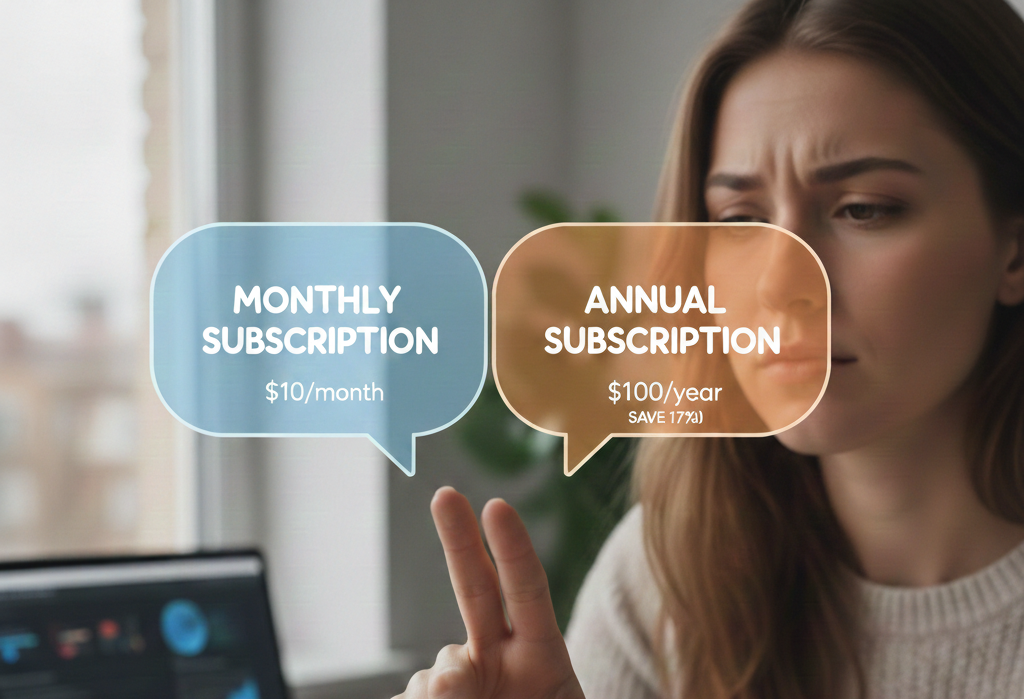
The core tradeoff: commitment vs flexibility
Monthly pricing is like a gym membership.
Low barrier to entry, easy to try, easy to leave.
Annual pricing is like buying the whole year upfront.
Higher commitment, less churn, and better cash flow.
In 2026, the "subscription fatigue" problem is real, making subscriber LTV a crucial metric to track. People are paying monthly for streaming, software, AI tools, fitness apps, cloud storage, and a dozen other things. That makes the monthly decision heavier than it used to be.
So the question becomes:
- Do you want more people to try you? (monthly helps)
- Or do you want fewer people, but a much higher chance they stick? (annual helps)
Why monthly pricing still wins in many cases
Monthly pricing makes sense when you're optimizing for growth and experimentation.
1) You're still proving the value
If your paid product isn't clearly defined yet (maybe the content cadence changes, you're still finding your voice, or your premium offering is "v2" at best), monthly is a safer ask.
People will take a chance on $10 for a month.
They won't take a chance on $100 for a year unless the value is obvious.
2) Your newsletter is "ongoing value," not "compounding value"
Some newsletters are evergreen and stack over time (deep research, databases, playbooks, templates, courses, archives). Others are more like a weekly signal.
If your premium content is mostly:
- weekly commentary
- timely market takes
- curated links
- "what happened this week" insights
...then monthly fits naturally, because the value is tied to staying current.
3) Your audience has uncertain budgets
Freelancers, students, early-stage founders, creators: many of them prefer keeping optional costs flexible. In a world where people routinely pause subscriptions, monthly feels controllable.
4) It's easier to sell with trials and promos
Monthly pricing plays well with:
- "first month free"
- $1 for 30 days
- launch discounts
- "upgrade anytime"
That matters if you're using content marketing or social media funnels and want people to try before they trust you.
Downside: churn.
Even if your newsletter is great, monthly makes leaving frictionless. People cancel when they're busy, not just when you're bad.
Why annual pricing is stronger than ever in 2026
Annual pricing makes sense when you're optimizing for retention, stability, and serious subscribers.
1) Churn is a silent killer, and annual pricing is the antidote
Let's be blunt: most newsletters don't fail because they can't get subscribers.
They fail because they can't keep them.
Monthly churn forces you to constantly refill the bucket. Annual pricing reduces that pressure because:
- you lock in revenue longer
- subscribers commit psychologically
- and you get runway to improve the product without panicking every month
2) It aligns with "identity subscriptions"
The best newsletters aren't just information, they're belonging.
If subscribing signals "I'm the kind of person who takes investing seriously" or "I'm building a business and I want sharper thinking," annual pricing becomes an easy yes. It feels like joining something, not renting something. This ties into the psychology of pricing — identity drives retention.
3) Better cash flow = better product
Upfront cash changes behavior. It lets you:
- outsource design/editing
- buy data/tools
- invest in better onboarding
- spend on acquisition confidently
- and generally act like a business instead of a hobby
That's why many creators quietly prefer annual: it makes the whole operation calmer.
4) Annual is a discount story people understand
People expect annual to be cheaper per month. And in 2026, with cost sensitivity rising, "save 20%" is a clean pitch.
But here's the real secret: the discount is often less important than the relief of paying once and forgetting about it.
Downside: higher purchase friction.
Annual is harder to sell, especially to new readers who haven't experienced the premium value yet.
The model that usually wins: monthly + annual (default to annual)
If you only remember one thing, make it this:
The smartest setup for most paid newsletters in 2026 is offering both, then nudging people toward annual.
Why?
- Monthly captures the "I'm curious" crowd.
- Annual captures the "I'm convinced" crowd.
- And you don't force one audience to behave like the other.
How to nudge toward annual without being sleazy
- Make annual the "best value" highlighted option.
- Price monthly slightly higher than you think (so annual feels like a deal).
- Add an annual-only perk that costs you almost nothing:
- a quarterly Q&A
- a yearly PDF compendium
- a private archive collection
- a "members-only" spreadsheet/template pack
- priority replies
This creates a legitimate reason for annual beyond "please give me cash upfront."
Practical pricing math (simple, but important)
Here's a clean framework:
Pick a monthly price that feels fair without apologies.
If you're constantly justifying $10/month, it's too high for your current value.
Set annual at 10-20% off the monthly equivalent.
Example:
- $12/month -> $144/year equivalent
- Annual price: $120-$130/year
Decide what you want to optimize:
- If you want more annual signups, increase the discount.
- If you want more revenue per subscriber, decrease the discount but add perks.
The goal isn't to "find the perfect number."
It's to create a pricing structure that matches your growth stage and content strength.
So... which makes more sense in 2026?
Here's the blunt decision rule:
Choose monthly-first if:
- your premium offer is still evolving
- your audience is price-sensitive
- you rely on timely content
- and you want more people to try you
Choose annual-first if:
- your newsletter has compounding value (archives, tools, research)
- your retention is good (or you want it to be)
- you want predictable revenue
- and you're building a long-term membership vibe
For most newsletters that want to become real businesses in 2026, the best answer is:
Offer both. Make annual the hero. Use monthly as the on-ramp.
Related Articles
- Optimal Price for Your Newsletter
- Psychology of Pricing Paid Newsletters
- Are You Underpricing Your Audience?
Want to see annual vs monthly impact on your newsletter's valuation? Run both scenarios with the Free Newsletter Valuation Tool.